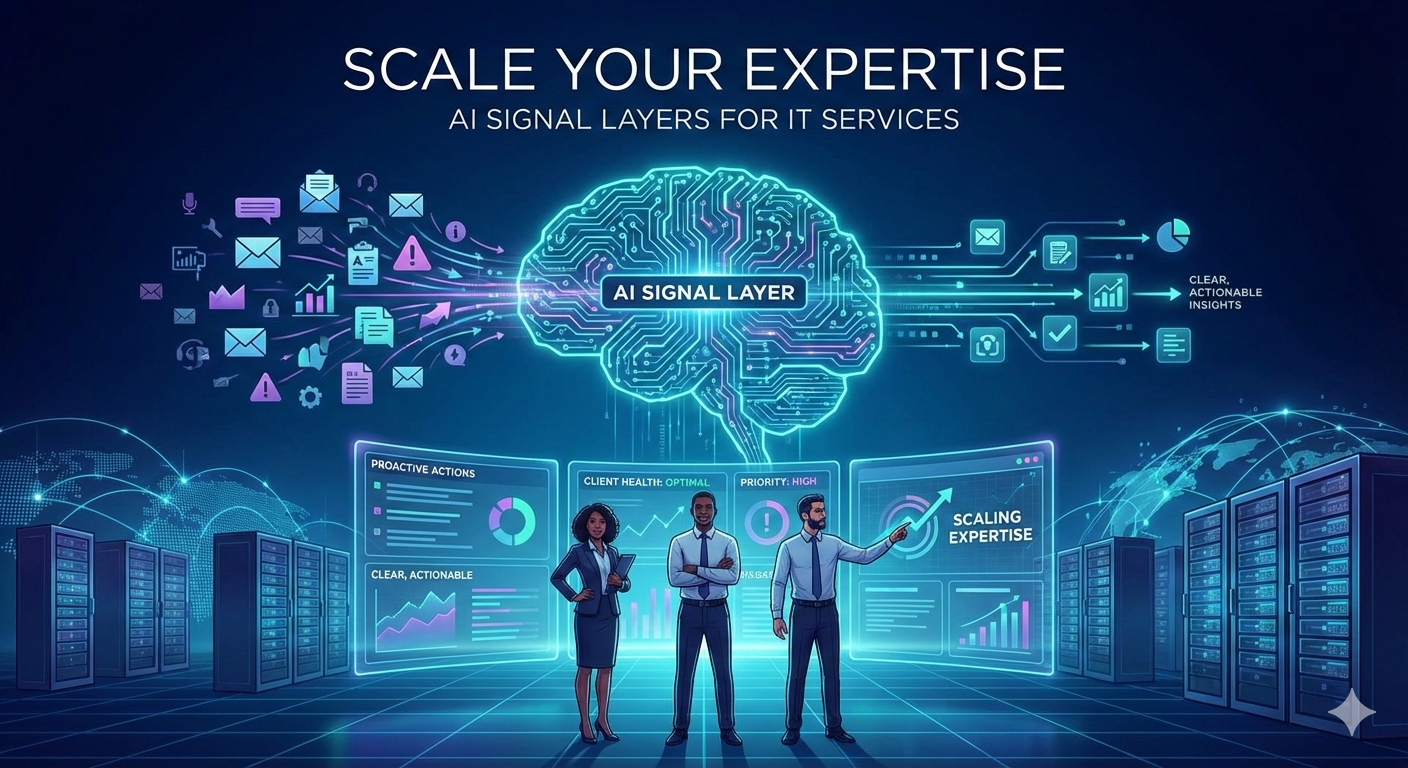
The Talent Paradox: Why Your Best IT Service Delivery Teams Can't Scale (And Why Hiring More People Won't Fix It)
How AI Signal Layers Let Lean Teams Perform Like Enterprise Customer Success Departments Without the Enterprise Headcount
The Problem - You Can't Clone Your Best People
You've built a great IT service business. Your clients love you. Your team knows their stuff. Then you land three new enterprise clients in a quarter, and suddenly, everything breaks.
Not because your team isn't talented—but because there simply aren't enough hours in the day. Your top performers are drowning in reactive work, spending their mornings triaging tickets and their afternoons hunting through Slack channels trying to figure out which client fire to put out first.
Here's the cruel irony: the very skills that make your delivery team exceptional, deep client knowledge, technical expertise, and relationship intuition, don't scale. You can't clone your best account manager. You can't bottle the instinct that tells your senior engineer that the client who sent a polite "just checking in" email last Tuesday is actually three weeks away from churning.
So you do what every growing service provider does: you hire. More engineers. More account managers. More project coordinators. And your margins shrink with every new employee badge you print.
How The Talent Paradox Crushes Growing IT Service Providers
The talent paradox creates a vicious cycle that traps growing IT service providers:
Revenue Growth Becomes a Profitability Problem
Every new client requires additional headcount to service properly. Your gross margins stay stuck while SaaS companies in your space operate at significantly higher margins. Growth doesn't compound—it just gets heavier.
According to Service Leadership Index data from TSIA (Technology & Services Industry Association), professional services organizations typically operate at 25-35% gross margins, while software-as-a-service companies average 70-80% gross margins. The fundamental difference? Services scale linearly with headcount; software scales exponentially with infrastructure.
Your Best People Become Bottlenecks
The senior engineer who can sense a brewing infrastructure issue from a 2-line ticket description? She's now spending hours in status meetings because she's the only one who "gets" your top accounts. Her expertise can't transfer because it's built on thousands of micro-interactions that never got documented.
Onboarding Takes Forever, and the ROI Never Materializes
New hires take 6-9 months to become productive because there's no systematic way to transfer tribal knowledge. By month 4, they're handling tickets. By month 7, they might understand the nuances of your top client's environment. By month 10, they've been recruited away.
Research from TSIA's State of Customer Success report shows that the average time to productivity for technical customer success roles is 5.8 months—and that's in companies with formal onboarding programs.
You're Constantly Playing Defense
Your delivery team spends the majority of their time on reactive work—responding to tickets, answering "quick questions," putting out fires. The strategic work that actually prevents churn and drives expansion gets perpetually pushed to "next week."
The Solution - AI Signal Layers That Scale Your Expertise
The breakthrough isn't hiring smarter people or implementing better processes—it's creating a signal layer that does the cognitive work your team is currently burning hours on.
Think about how enterprise Customer Success teams operate. They're not smarter than your delivery team. They just have infrastructure: automated health scores, early warning systems, playbook engines that route the right intervention to the right CSM at the right time.
They've essentially built an AI layer that watches everything and tells humans exactly where to focus.
IT service providers can now do the same thing—without building a CS ops team or buying six different monitoring tools.
This is where Prioriwise fundamentally changes the economics of service delivery.
Instead of your delivery team manually synthesizing signals from tickets, emails, Slack, monitoring tools, and client interactions, Prioriwise creates an intelligent signal layer that:
1. Aggregates Every Client Signal in Real-Time
Prioriwise connects to your existing stack—PSA tools, email, Slack, monitoring platforms—and creates a unified view of client health. But unlike a dashboard (which just shows you more data to interpret), it analyzes patterns:
Ticket volume trends and severity shifts
Communication frequency and sentiment changes
Response time degradation
Technical metrics and infrastructure signals
Contract milestones and renewal timelines
2. Translates Signals Into Human-Ready Actions
Here's the magic: Prioriwise doesn't just alert you that "Client X ticket volume increased 40%."
It tells you: "Client X is showing early warning signs of churn. Three engineers have logged frustration about response times in Slack. Recommend: Schedule executive alignment call this week. Here's a suggested talk track based on their recent issues."
Your delivery team goes from "detective work" to "execution mode" in seconds.
3. Scales Your Best People's Intuition
The senior engineer who can spot trouble brewing? Prioriwise learns from her. When she marks certain signal combinations as high-priority, the system recognizes those patterns across your entire client base.
Her expertise becomes institutional knowledge that works 24/7 across 100 clients instead of the 8 she can personally monitor.
4. Enables True Proactive Service Delivery
With Prioriwise handling the "what to do next" decisions, your team shifts from majority reactive to majority proactive work. They're reaching out to clients before problems become escalations. They're having expansion conversations at exactly the right moment. They're demonstrating value in every interaction because they have perfect context.
The math transforms completely:
Instead of needing one account manager per 8-10 clients, you can comfortably manage 15-20
Instead of senior engineers spending hours prioritizing, they're executing
Your 12-person delivery team can suddenly handle a 50-client portfolio that would typically require 18-20 people
That's the difference between 30% margins and 55% margins. That's the difference between hiring your way to growth and actually scaling.
What Happens When You Implement an AI Signal Layer
When you implement an AI signal layer, something remarkable happens: your team gets better as you grow, not more overwhelmed.
New clients don't mean chaos—they mean more data for the system to learn from, which makes everyone more effective.
Your best people stop being bottlenecks and start being force multipliers. The tribal knowledge that used to walk out the door with every employee departure becomes systematized. Onboarding drops from 6 months to 6 weeks because new team members have an AI copilot telling them exactly what matters and why.
Most importantly, your unit economics finally make sense. You can:
Grow revenue without proportionally growing costs
Compete for enterprise deals without needing enterprise headcount
Deliver white-glove service at scale
Prioriwise doesn't replace your delivery team's expertise—it amplifies it across every client, every day, without hiring a single additional person.
Why We're Building Prioriwise
At Prioriwise, we're obsessed with a simple question: Why should IT service providers have worse economics than SaaS companies?
The answer has always been "because services require humans to deliver, and humans don't scale." But that's only true if humans are spending their time on tasks that AI can now handle better—pattern recognition, signal synthesis, prioritization, context gathering.
We believe the future of IT service delivery isn't about replacing people with automation. It's about building AI infrastructure that handles the meta-work—the cognitive overhead that currently prevents great teams from reaching their potential.
Every IT service provider we work with has the same moment of clarity: they realize they've been paying their most expensive talent to do work that a properly trained AI can do in milliseconds. And when they free those people up to do what they're actually brilliant at—solving complex problems, building relationships, architecting solutions—everything changes.
We're building Prioriwise to be the signal layer that every modern IT service delivery team deserves. The same infrastructure that enterprise CS teams take for granted, but purpose-built for the complexity of IT service delivery.
Because your team shouldn't need to choose between great margins and great service. They should have both.
Ready to Scale Your Team Without Scaling Headcount?
If you're tired of choosing between growth and profitability, let's talk.
✓ Reduce decision-making overhead by 60-70% — Turn hours of prioritization into minutes of execution
✓ Increase client coverage per team member by 40-60% — Without sacrificing service quality
✓ Systematize tribal knowledge — So your best people's expertise works across your entire portfolio
✓ Shift from reactive to proactive — Catch issues before they become escalations
See Prioriwise in Action
Book a 30-minute demo !
No generic slides—just real insights from your real portfolio.
Key Takeaways
Service delivery has a hidden tax: A significant portion of your team's time is spent on meta-work—deciding what to do, gathering context, prioritizing—rather than actually delivering value. This overhead compounds as you grow.
Tribal knowledge is your biggest scaling blocker: The expertise that makes your best people exceptional lives in their heads, not in your systems. Until you systematize pattern recognition and early warning detection, every new hire is starting from zero.
The path to better margins is through better signals, not cheaper labor: Instead of hiring more junior people to reduce costs, focus on giving your existing team the infrastructure to manage larger portfolios. One senior engineer with an AI signal layer can outperform three junior engineers drowning in noise.
Proactive service is a competitive moat—if you can afford to deliver it: Clients will pay premium rates for teams that catch problems before they escalate. The only way to do this at scale is to automate the detection and prioritization work that currently makes proactive service economically impossible.
Data Sources Referenced:
TSIA (Technology & Services Industry Association): https://www.tsia.com/
State of Customer Success Report: https://www.tsia.com/resources/state-of-customer-success
Ready to stop reacting and start predicting?
See how Prioriwise turns your delivery data into a live Relationship Health Score for every client.
Get Started